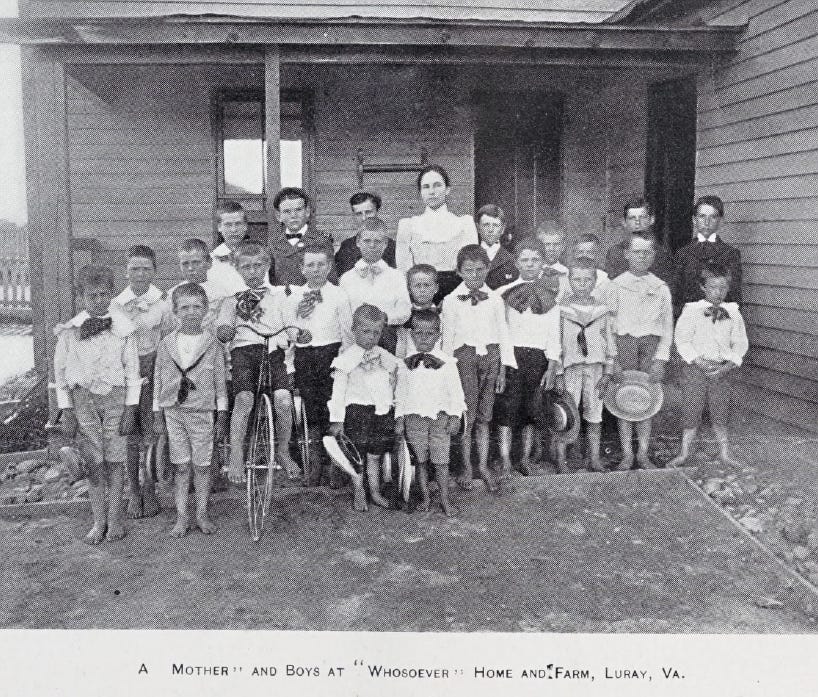
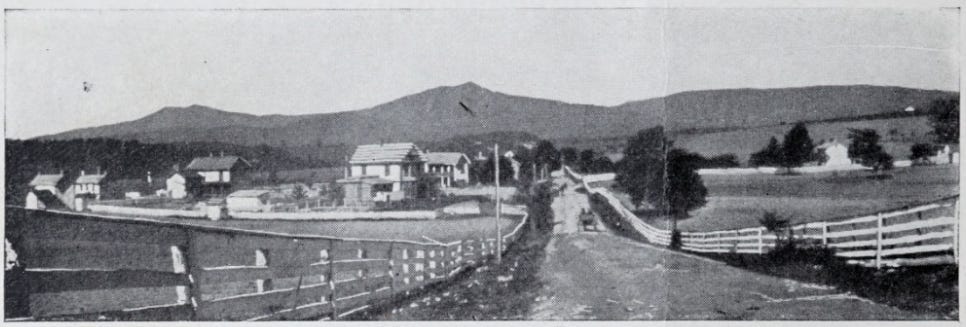
The door [at Whosoever Farm] in Luray, Virginia is open for destitute children without regard to creed or denomination, preference being given to the children of the fallen and outcast. The railroad and turnpike run through the farm, the water is abundant, the fine mountain air and the charming scenery make it peculiarly fitted for this enterprise. It is about five hours from Washington. — From a Wharton Orphanage prospectus
In Case You Missed It …


FROM THE LEXINGTON (MISSOURI) INTELLIGENCER - NOVEMBER 30, 1901
The Whosoever Farm in Virginia
Its Originator was the Rev. Dr. Wharton, Now Preaching at the Lexington Tabernacle
A HAVEN OF REST FOR HELPLESS CHILDREN
The "Whosoever Farm" at Luray, Virginia, a home for destitute children, grew out of the work of the Rev. Dr. Wharton, who is now con-ducting revival services in Lexington and that God's hand is in the labor all will admit. Dr. Wharton thus describes the first incident that lead to the founding of this home for the helpless:
About fourteen years ago while I was pastor in the city of Baltimore, I was walking along the street one day and met a lady who informed me that there were three little children of her acquaintance in desperate circumstances and entirely without assistance. She begged me to look after them, stating that their father had been killed, and their mother was in the penitentiary.
For several days, these little unfortunate ones were on my heart. Not knowing what to, I called a widow lady of my acquaintance who had a very comfortable home and no one living with her except her niece.
I proposed for them to take these children on the condition that I would be responsible for their board and clothing. They asked for time to consider the proposition, and a week later agreed to take them.
In less than a year there were 20, and in three years, 60 children to be cared for. We had to change our quarters twice to get more comfortable places. Having a small farm near Luray, Virginia in my possession, I determined to move these children to that point on account of the healthfulness of the place and the possibility of separating them from all influences that were not of the best character.
The years have passed on, the work has had its ups and downs, it’s bright days and dark days, it’s sick days and well days, but the children have never been without meals, good clothing and shelter.
From the very first, it has been non-sectarian, the only requirement being destitution. This its name imports; it is for ‘whosoever’ needs its care and aid.
Since the institution of this heaven-born home, over three hundred boys and girls have been taken from conditions of poverty, have been cared for, educated and sent out into the world with Christian independence and firm belief to make their way in life.
The children of soldiers are also cared for without regard to the color of the uniform worn by the veteran father. In discussing this feature of the work Dr. Wharton says:
We care for the children of soldiers also, and are now planning to build a large stone house to bear the name of Winnie Davis, the daughter of the Confederacy, the beautiful flower which was the pride of the south, and whose life was a joy and inspiration to our sunny land.
We have opened a cottage in her name, but the new one will be much larger and more permanent.
It is our purpose to care for any child or widow of our old veterans as long as there is room.
FROM THE PAGE NEWS AND COURIER - OCTOBER 1, 1937
While there has been an article written about the “Whosoever Farm" in a previous issue, Mrs. V.S. Milbourne of Charles Town WV has sent us additional information which is of interest.
Mrs. Melbourne's contribution is a copy of "The Evangel" a religious publication. dated June 1895, and published by Wharton & Barron at Baltimore.
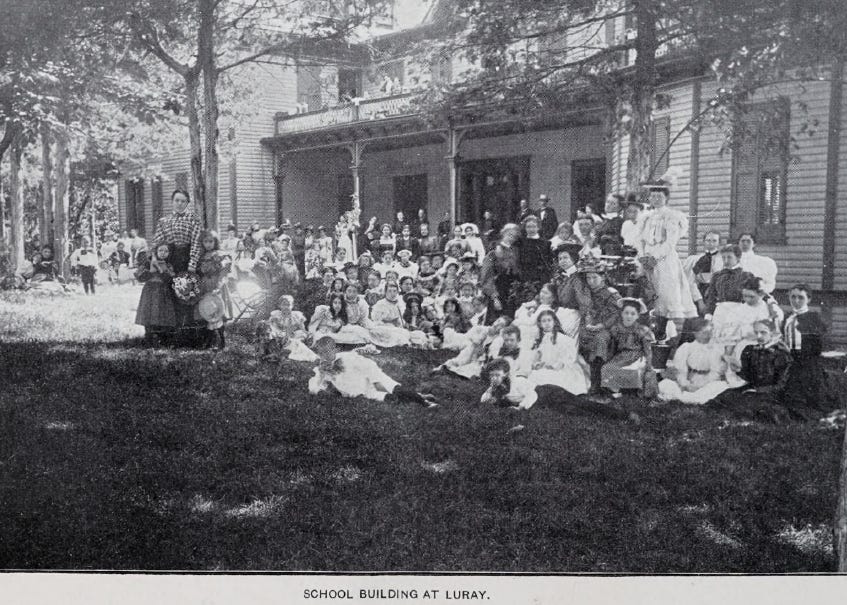
The front page carried a large picture of the Whosoever Farm, Luray, including a number of other former residents. Older residents can locate only two in the picture that they can recall —the late James B. Hudson and wife. parents of H. V. and Dr. W.L. Hudson, of Luray
The children pictured were all small and are now probably located in many sections of the country — one Bessie Booth, who married Charles Burner, with her three children were murdered about 20 years ago by a man named Nichols, in the Bixler’s Ferry neighborhood of this county.
Rev. Henry M. Wharton, a native of Culpeper County, was the prime mover in this orphanage as well as being at the head of the Luray College about this time.
Wharton was pastor of Main Street Baptist Church for a number of years, later going to Baltimore where he was pastor of Brantly Baptist church, for twenty years up until the time of his death, eight or ten years ago.
The Whosoever village is now quite a little community on our Eastern suburbs adjacent to the Lee Highway. Probably nine or ten homes now comprise the community.
Dr. Wharton was also an author of note, one of his novels being White Blood* which was similar to the Clansman. It included happenings in Culpeper and Page in the days immediately following the Civil War, and was highly interesting reading.
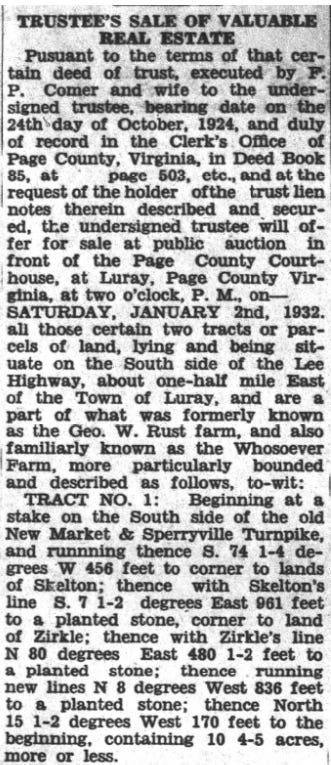
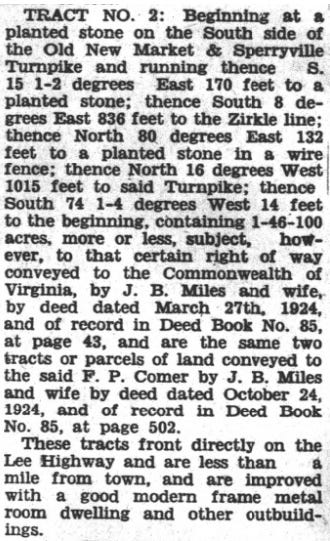
WHOSOEVER FARM SALE - LOCATION & FEATURES
Page News and Courier (December 25, 1931)
RELATED
* FREE PDF version of White Blood book (1906) - by H.M. Wharton
TRIBUTE to and OBITUARY of Rev. Henry Marvin Wharton
BESSIE BOOTH story and OBITUARY